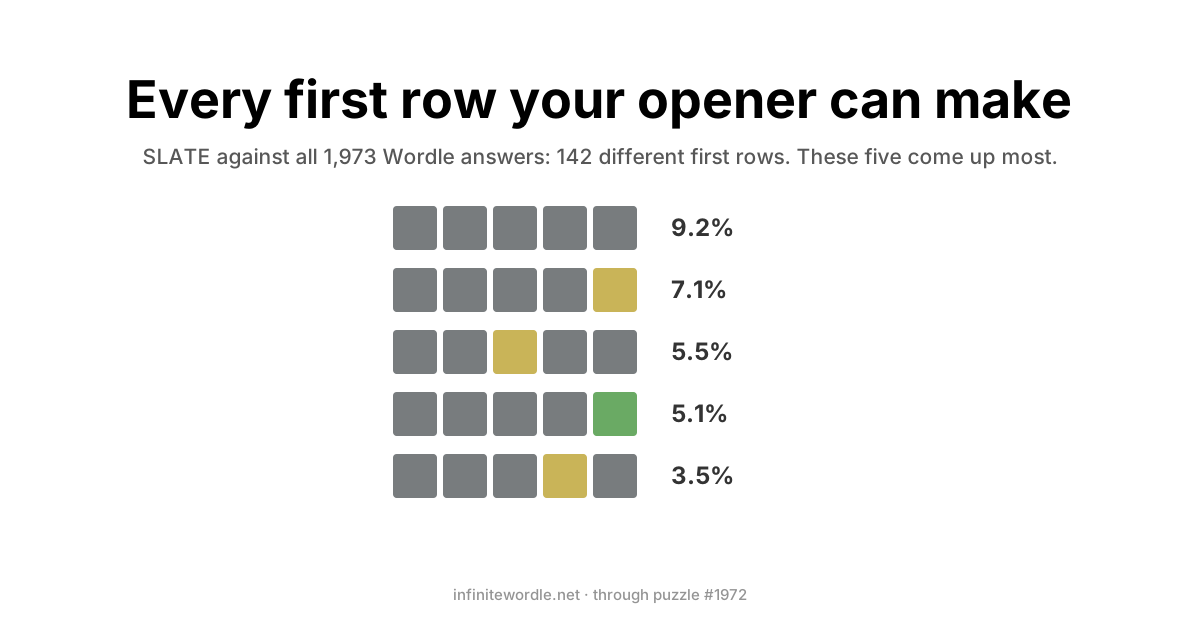
Every Wordle result that floods a group chat starts the same way: a row of colored squares and no letters. The first row is the one people read most closely.
It is also the one they misread most. A grey first row feels like a disaster; a green one feels like skill. Neither is quite right.
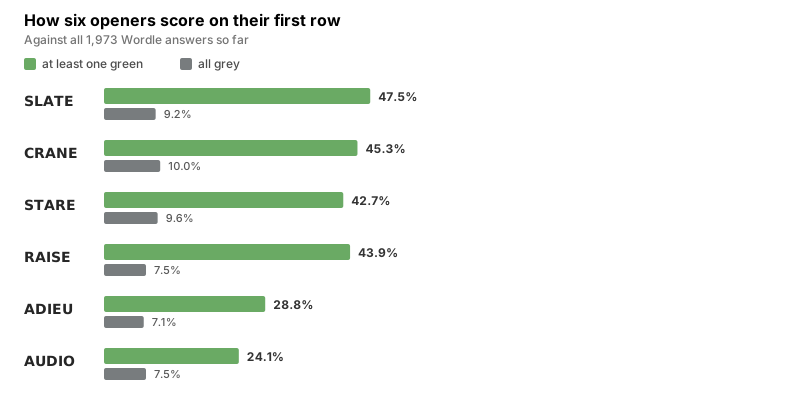
We scored six popular starting words against every Wordle answer so far, 1,973 puzzles. SLATE found at least one green on 47.5% of them; ADIEU managed 28.8%.
What you’ll learn:
- What the share grid records, and what it leaves out
- Why a grid row can only take 238 forms, not 243
- How six openers score on row one, puzzle after puzzle
- The first rows each opener produces most often
- How to turn a grid into a short, spoiler-free clip
What the Share Grid Records
The Wordle share grid is a spoiler-free record of a game: one row of colored squares per guess, with no letters. Green is the right letter in the right square, yellow is in the word elsewhere, and grey is not in the word.
The grid came from players, not the game. Josh Wardle added the share button after people started posting their results as emoji by hand.
Three colors, no letters
Each square is green, yellow or grey. That is all the grid keeps: the letters, and so the words, are stripped out.
That is the point. Anyone who has not played yet can see how your game went without learning the answer.
The score line above the grid
The text above the squares gives the puzzle number and your score, as in “Wordle 1,955 4/6”. An X in place of the number means the puzzle went unsolved.
An asterisk, as in “4/6*”, marks a hard-mode game. In hard mode, every green and yellow you find has to be used in later guesses.
Light, dark and high-contrast squares
Grey squares come out white or black depending on your theme. A grid shared from dark mode uses ⬛; from light mode, ⬜.
High-contrast mode, built for color-blind players, swaps the green and yellow for orange and blue. The meaning is the same: 🟧 is right square, 🟦 is right letter.
243 Rows in Theory, 238 in Practice
Five squares in three colors makes 3 × 3 × 3 × 3 × 3 = 243 possible rows. Five of them can never appear on a board.
The row that can’t exist
Four greens and one yellow is impossible. The yellow letter would need a home somewhere else in the answer, and every other square is already taken by a green.
That rules out one row for each position of the yellow, which leaves 238. We checked by scoring thousands of guesses against every answer: the five never turn up.
How many rows one opener actually makes
Over 1,973 puzzles, SLATE has produced 142 different first rows. That is well over half of everything a row can be.
Vowel-heavy openers are narrower. ADIEU has made only 76, because its letters cluster in yellow and rarely land in place.
How Six Openers Score on Row One
Here is how each opener would have scored on every puzzle in the archive. Every figure counts all 1,973 answers.
| Opener | Any green | All grey | Avg greens | Avg yellows | Rows seen |
|---|---|---|---|---|---|
| SLATE | 47.5% | 9.2% | 0.64 | 1.06 | 142 |
| CRANE | 45.3% | 10.0% | 0.62 | 1.04 | 139 |
| STARE | 42.7% | 9.6% | 0.59 | 1.19 | 135 |
| RAISE | 43.9% | 7.5% | 0.55 | 1.22 | 124 |
| ADIEU | 28.8% | 7.1% | 0.31 | 1.19 | 76 |
| AUDIO | 24.1% | 7.5% | 0.27 | 1.06 | 87 |
Consonant openers find greens
SLATE, CRANE, STARE and RAISE all find at least one green on more than four first rows in ten. Their letters are common, and they sit in the squares where answers tend to put them.
The E at the end does a lot of that work, as the next sections show.
Vowel openers find yellows
ADIEU and AUDIO are built to find vowels, and they do: their rows are full of yellow. But they land in the right square far less often, at 28.8% and 24.1%.
That is the trade. A vowel opener tells you which vowels are in play; a consonant opener tells you more about where letters sit.
Across 1,973 Wordle puzzles, SLATE’s first row held at least one green 47.5% of the time and ADIEU’s 28.8%. Consonant openers find where letters go; vowel openers mostly find which letters are there.
An all-grey row is not a disaster
An all-grey first row feels like a wasted guess. For SLATE it happens on 9.2% of puzzles, and it rules out five of the most common letters in the game at a stroke.
Your second guess can then spend all five squares on fresh letters. That is often a better position than a single yellow you cannot place.
The Most Common First Rows
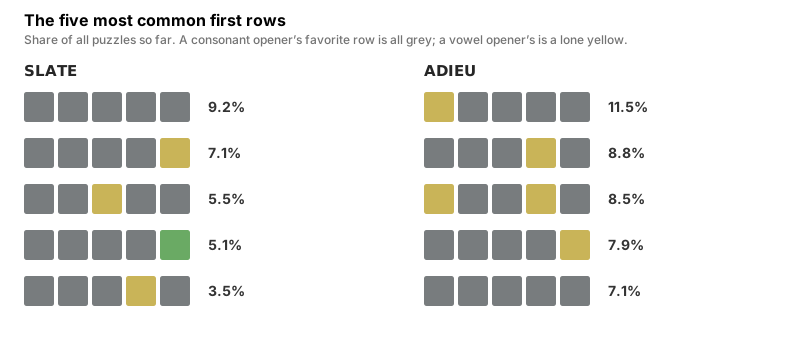
Every opener has rows it produces again and again. Here are the five most frequent for SLATE and ADIEU, as a share of all puzzles.
| # | SLATE | Share | ADIEU | Share |
|---|---|---|---|---|
| 1 | ⬜⬜⬜⬜⬜ | 9.2% | 🟨⬜⬜⬜⬜ | 11.5% |
| 2 | ⬜⬜⬜⬜🟨 | 7.1% | ⬜⬜⬜🟨⬜ | 8.8% |
| 3 | ⬜⬜🟨⬜⬜ | 5.5% | 🟨⬜⬜🟨⬜ | 8.5% |
| 4 | ⬜⬜⬜⬜🟩 | 5.1% | ⬜⬜⬜⬜🟨 | 7.9% |
| 5 | ⬜⬜⬜🟨⬜ | 3.5% | ⬜⬜⬜⬜⬜ | 7.1% |
SLATE’s favorite row is all grey
The single most common SLATE row, at 9.2%, is five grey squares. Next come a lone yellow E and a lone yellow A.
None of the top five has more than one colored square. A first row that lights up two or three squares is the exception, not the rule.
ADIEU’s favorite row is a lone yellow
ADIEU’s most common row is a single yellow in square 1, at 11.5%. The A is in the answer, just not at the front.
That is ADIEU in a nutshell. It reliably finds vowels and rarely pins one down.
Reading a single yellow
A single yellow tells you two things: the letter is in the answer, and not in that square. Both matter.
The second guess should move that letter somewhere new. Leaving it in the same square wastes a slot on information you already have.
Which Squares Turn Green
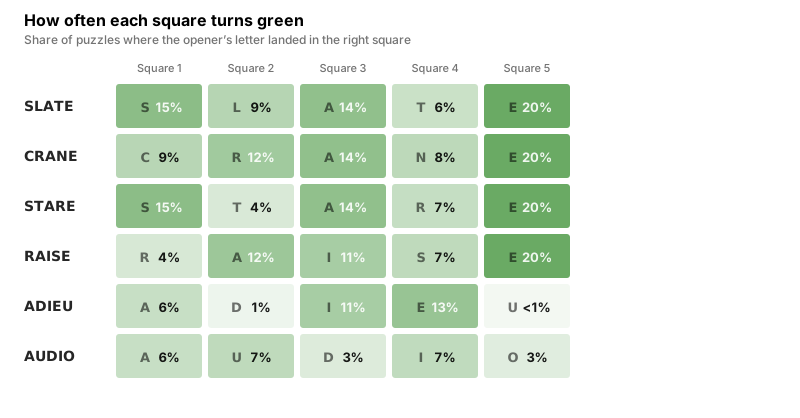
Not every square is equally likely to turn green. The pattern says as much about Wordle’s answers as about the openers.
The E in square 5
Every opener here that ends in E turns square 5 green on 20% of puzzles. That is simply how often Wordle answers end in E.
E closes nearly one answer in five, as our look at why Wordle answers almost never end in S found. An opener ending in E collects that green for free.
ADIEU’s U almost never lands
ADIEU puts U in square 5, and only 2 Wordle answers in 1,973 have ended in U. That square is effectively a yellow-or-nothing slot.
It is the clearest case of a letter that helps you find vowels while doing almost nothing for placement.
Square 4 rarely turns green
For the four consonant openers, square 4 lands on fewer than one puzzle in ten: SLATE’s T on 6%, CRANE’s N on 8%.
The likeliest fourth letter in a Wordle answer is E, and every one of these openers spends its E on square 5 instead.
Turn Your Grid Into a Short Clip
A grid is already a picture of your game. With a little effort, it can be a short clip of the game unfolding.
Keep it spoiler-free
Whatever you make, share the colored squares, not the letters. A clip of a solved board with the answer showing spoils the puzzle for everyone who has not played yet.
The safest source is the share grid itself, pasted into a note or a blank image. It has no letters to leak.
Screen recording is the simple option
Most phones and computers can record the screen. Replay your game, record the board filling in row by row, and trim the result.
It is accurate by definition, because it is the real board. The catch is that a recording shows the letters, so it is a spoiler until the day’s puzzle is over.
Animating from an empty board
If you would rather start from images, Imgveo’s start and end frame mode can generate a short video between two pictures. Use an empty grid as the first frame and your finished, letter-free grid as the last.
Check the clip before you post it
A generated clip can redraw squares or shift colors between frames. Compare the last frame with your real grid: a clip that changes your score is no longer your game.
Reading Someone Else’s Grid
A shared grid is a small puzzle of its own. Here is what it can and can’t tell you.
A 2/6 usually starts with a strong first row
Solving in two needs a first row that narrows the answer to a handful of words. That almost always means several greens or yellows.
Even then, some luck is involved. But a 2/6 grid’s first row tends to be far busier than the typical rows shown above.
The first row hides the opener
You cannot tell from a grid which word someone opened with. Thousands of words can produce the same row of colors on the same day.
That is the grid working as designed: it shows how well you played, never what you played.
Methodology
Scoring. Each opener was scored against every answer in our archive of 1,973 puzzles using Wordle’s rules: greens first, then yellows from the letters left over, so a repeated letter in a guess cannot claim more yellows than the answer has copies.
Openers. SLATE, CRANE, STARE, RAISE, ADIEU and AUDIO were chosen as widely used starting words, consonant-heavy and vowel-heavy. This page compares their first rows; for a ranking of openers, see the best Wordle starting words.
Possible rows. The 238-row figure was confirmed by scoring thousands of valid guesses against the full answer pool: no other row ever appears.
Freshness. Every percentage recomputes on each site build, so the figures move with every new puzzle.