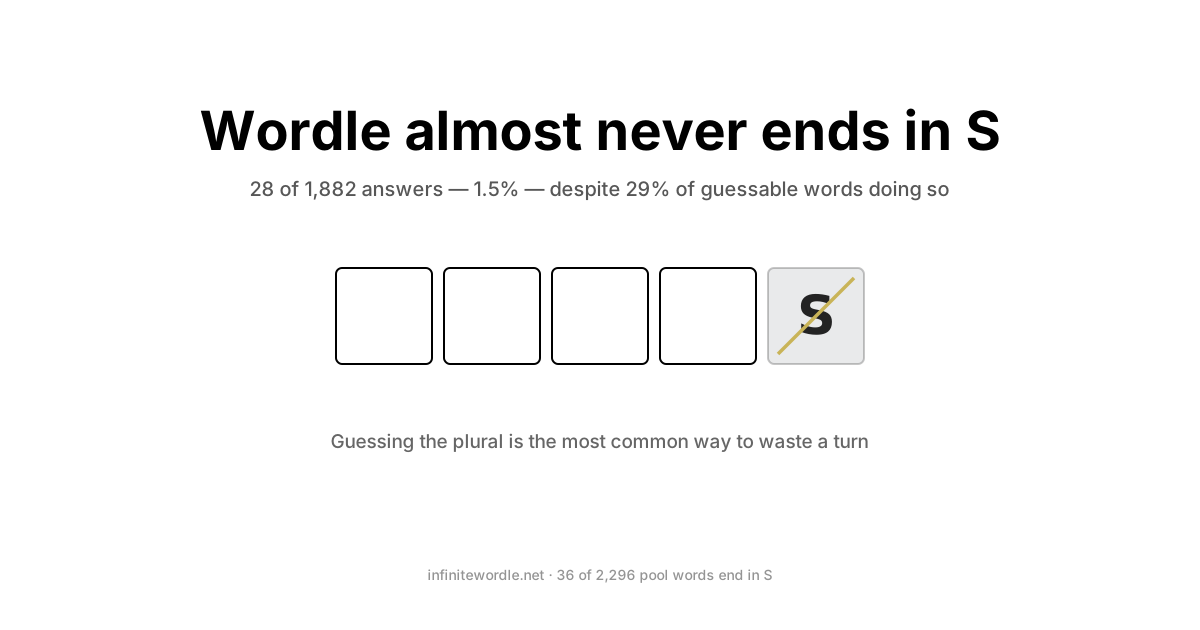
You have four green letters, one square left, and the obvious answer is a plural. You type it. It is wrong.
That is the most reliable way to waste a guess in Wordle, and the data explains why. Of 1,916 puzzles played to date, 29 answers have ended in S — 1.5%.
More striking: not one of them was a plural.
What you’ll learn:
- Why S endings are common in the dictionary but absent from answers
- The three filters that strip plurals out before the puzzle picks
- What Wordle answers actually end in instead
- Where S is worth guessing — and it is a lot more common than you think
- The 28 exceptions, listed in full
The Trap: Why Everyone Guesses Plurals
The instinct is sound. English is full of plurals, and a five-letter plural is just a four-letter word with an S bolted on.
That makes plurals feel like free candidates. When you are stuck, the mind reaches for CARTS, BOOKS, LINES — words you did not have to work to find.
The trap is that “easy to think of” and “likely to be the answer” are close to unrelated in Wordle.
The letter itself is not the problem
S is genuinely a common letter. It appears somewhere in a large share of answers, and testing it early is good strategy.
The problem is specific to position five. S is welcome anywhere else in the word.
What the guess list tells you
Type any plural and Wordle accepts it. That acceptance is easy to misread as a hint that plurals are in play.
They are not. The guess list and the answer list are two different things, and the gap between them is where this whole article lives.
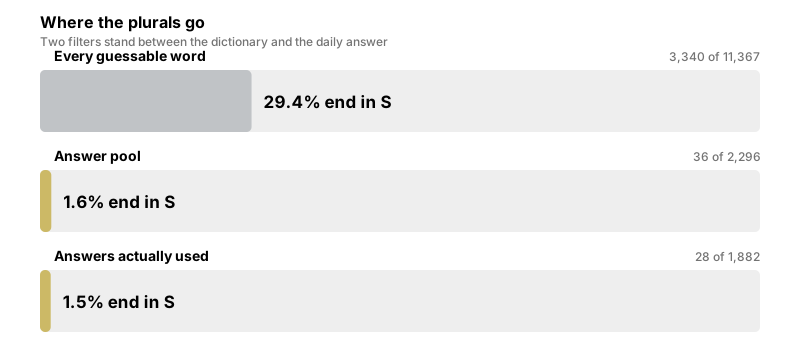
The Numbers: Three Layers of Filtering
Follow an S-ending word through Wordle’s plumbing and it gets filtered twice.
| Stage | Words ending in S | Total | Share |
|---|---|---|---|
| Words Wordle accepts as guesses | 3,340 | 11,367 | 29.4% |
| Curated answer pool | 36 | 2,296 | 1.6% |
| Answers actually used | 29 | 1,916 | 1.5% |
Nearly 30% of the words Wordle lets you type end in S. Only 1.5% of the words it has ever answered with do. The filtering happens before you ever see the puzzle.
Layer 1 — the dictionary is full of them
3,340 of the 11,367 accepted guesses end in S, or 29.4%. English does this: almost any four-letter noun becomes a five-letter plural.
If Wordle drew answers from this list at random, roughly three in ten would end in S.
Layer 2 — the answer pool cuts them out
The curated pool holds just 36 S-ending words out of 2,296. That is a drop from 29.4% to 1.6% — a cut of more than 90%.
This is the decisive step, and it was a human decision. Josh Wardle built the answer list by hand, keeping words that felt satisfying to solve.
A plural is not satisfying. Solving to CARTS feels like solving to CART with a formality attached.
Layer 3 — chance does the rest
From a pool already down to 36 candidates, 29 have actually come up in 1,916 puzzles.
That final drop from 1.6% to 1.5% is small and within what randomness alone would produce. The real work was done at layer 2.
Not One Answer Has Been a Plural
Here is the finding that surprised us. We expected S endings to be rare. We did not expect the category to be empty.
All 29 S-ending answers, in order of appearance:
| Puzzle | Date | Answer |
|---|---|---|
| #31 | 2021-07-20 | FLOSS |
| #67 | 2021-08-25 | CRASS |
| #126 | 2021-10-23 | ABYSS |
| #196 | 2022-01-01 | REBUS |
| #198 | 2022-01-03 | TRUSS |
| #267 | 2022-03-13 | FOCUS |
| #334 | 2022-05-19 | GLASS |
| #446 | 2022-09-08 | CLASS |
| #591 | 2023-01-31 | CROSS |
| #657 | 2023-04-07 | LOCUS |
| #769 | 2023-07-28 | ETHOS |
| #789 | 2023-08-17 | AMISS |
| #1054 | 2024-05-08 | PIOUS |
| #1060 | 2024-05-14 | AMASS |
| #1074 | 2024-05-28 | MINUS |
| #1077 | 2024-05-31 | CHAOS |
| #1181 | 2024-09-12 | BRASS |
| #1188 | 2024-09-19 | PRESS |
| #1298 | 2025-01-07 | ATLAS |
| #1331 | 2025-02-09 | BONUS |
| #1410 | 2025-04-29 | BLISS |
| #1490 | 2025-07-18 | LORIS |
| #1581 | 2025-10-17 | GROSS |
| #1636 | 2025-12-11 | GUESS |
| #1642 | 2025-12-17 | GRASS |
| #1735 | 2026-03-20 | OASIS |
| #1772 | 2026-04-26 | GLOSS |
| #1809 | 2026-06-02 | BASIS |
| #1912 | 2026-09-13 | FOCUS |
Read that column. FOCUS. CHAOS. ABYSS. BASIS. ETHOS. OASIS. BLISS.
Every one is a singular word
Not a single entry is a plural formed by adding S to a shorter word. They fall into a few tidy groups:
- Mass nouns — CHAOS, BLISS, FLOSS, GRASS, BRASS, GLASS
- Latin and Greek singulars — FOCUS, LOCUS, ETHOS, BASIS, OASIS, ATLAS
- Adjectives and adverbs — CRASS, PIOUS, GROSS, AMISS
- Verbs and singular nouns — PRESS, GUESS, AMASS, DRESS
The distinction that matters at the board
CARTS is a plural. CRASS is not. Both end in S, and only one of them can be today’s answer.
When your clues put an S in the final square, you are not looking for a plural. You are looking for a word that was always spelled that way.
In 1,916 Wordle puzzles, no answer has ever been a plural. Every S-ending answer — FOCUS, CHAOS, ABYSS, BASIS — is a singular word that happens to end in S.
The pattern is bigger than plurals
Once you see it with S, the same shape shows up elsewhere. Wordle is not avoiding a letter. It is avoiding inflected forms — words built by bolting an ending onto a shorter word.
| Ending | Answers | Share of answers | Share of guess list |
|---|---|---|---|
| -ES | 0 | 0.0% | 5.4% |
| -ED | 11 | 0.6% | 4.0% |
| -S | 29 | 1.5% | 29.4% |
| -ING | 16 | 0.9% | 0.4% |
| -ER | 107 | 5.7% | 3.5% |
| -Y | 261 | 13.9% | 10.0% |
The top three rows are the inflections, and all three are suppressed relative to the dictionary. The bottom rows are not inflections, and they run above their dictionary share.
-ES has never happened at all
Not once. 1,916 puzzles, zero answers ending in -ES, against 5.4% of the guess list. That is the emptiest category in the game.
Past tenses are absent too
Eleven answers end in -ED, which sounds like a real category until you read them: UNFED, BLEED, TWEED, STEED, FRIED, BREED, GREED, SPEED, EMBED, SHRED, CREED.
Every single one is a word that was always spelled that way. Strip the D and nothing valid remains. There has never been a WALKED or a JUMPED.
Wordle has never used a plural, never used an -ES word, and never used a past tense formed by adding -ED. Three whole categories of English are simply not in the game.
How confident should you be?
This is an observed pattern, not a published rule. The Times has never stated that plurals are barred.
But 1,916 puzzles is a large sample, and the pool itself contains almost no plurals to draw from. Treat it as close to a rule and you will be right far more often than not.
What Wordle Answers End In Instead
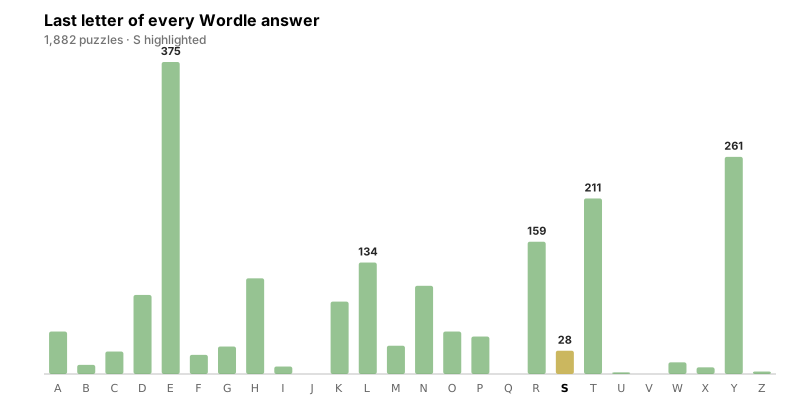
If not S, then what? The distribution is lopsided in a way that is directly useful.
| Rank | Last letter | Answers | Share |
|---|---|---|---|
| 1 | E | 382 | 19.9% |
| 2 | Y | 268 | 14.0% |
| 3 | T | 215 | 11.2% |
| 4 | R | 162 | 8.5% |
| 5 | L | 135 | 7.0% |
| 6 | H | 115 | 6.0% |
| 7 | N | 111 | 5.8% |
| 8 | D | 96 | 5.0% |
| 9 | K | 88 | 4.6% |
| 10 | A | 52 | 2.7% |
E is the default guess
E closes 382 answers — 19.9% of everything. If you know nothing else about the last square, E is the bet.
That single fact is worth more than any amount of plural intuition.
Y is the underrated one
Y takes second place with 268 answers. Players consistently under-guess it because Y feels like an unusual letter.
It is not, at the end of a word. HAPPY, DUSTY, MERRY, PROXY — the pattern is everywhere once you look for it.
The top four cover most of the board
E, Y, T and R together close a majority of all answers. Working down that list in order will beat guessing far more often than reaching for a plural.
Where S Actually Belongs
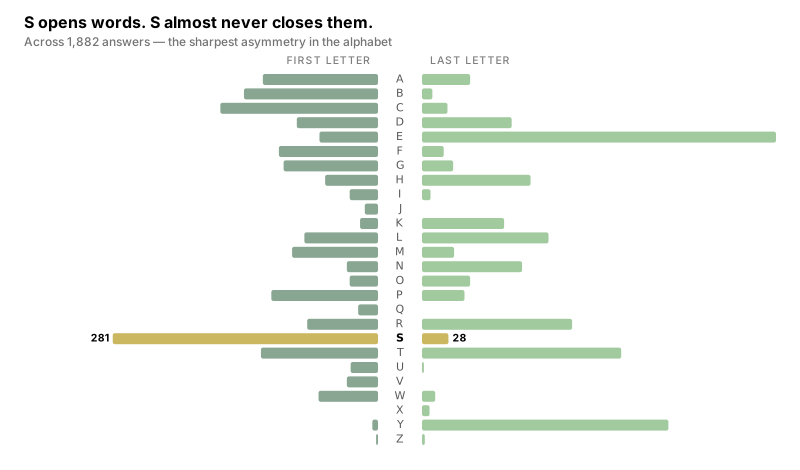
None of this makes S a bad letter. It makes S a positional letter, and the asymmetry is the sharpest in the game.
S opens more answers than any other letter
S starts 285 answers, more than any other letter in the alphabet. It ends only 29.
That is a ten-to-one split. No other letter comes close to that imbalance.
Reading a yellow S correctly
A yellow S is one of the most informative tiles you can get, because it eliminates the position most players would try first.
If S is present but not in square five, the front of the word is where to look. SHIRT, STAMP, SCALE, SPINE — the S-opening space is enormous.
S in the middle is common too
Squares two, three and four all take S regularly. The one dead zone is the end.
| Square | Answers with S here | Rank among all letters |
|---|---|---|
| 1 | 285 | #1 |
| 2 | 18 | #15 |
| 3 | 58 | #11 |
| 4 | 140 | #4 |
| 5 | 29 | #15 |
Square one is S territory and square five is not. The three middle squares sit in between, each taking S often enough to be worth testing.
Put differently: there is exactly one square where S is a bad bet, and it is the square everyone guesses first.
If It Really Does End in S, the List Is Short
Suppose your clues are unambiguous: the last square is S. You are not out of luck, because the candidate set is small enough to hold in your head.
The answer pool contains 36 words ending in S. 29 have already been used. That leaves 12 that have never appeared:
| Word | Type |
|---|---|
| BLESS | Mass or singular noun |
| CHESS | Mass or singular noun |
| CRESS | Mass or singular noun |
| DRESS | Mass or singular noun |
| DROSS | Mass or singular noun |
| FETUS | Latin singular |
| FICUS | Latin singular |
| HUMUS | Latin singular |
| LUPUS | Latin singular |
| MUCUS | Latin singular |
| TORUS | Latin singular |
| VIRUS | Latin singular |
Two families, no plurals
Sort those 12 words and they fall into exactly two groups.
The -US words are Latin singulars: FETUS, FICUS, HUMUS, LUPUS, MUCUS, TORUS, VIRUS. The -ESS and -OSS words are mass nouns and verbs: BLESS, CHESS, CRESS, DRESS, DROSS.
Not one is a plural. The pattern holds right through to the words that have not been used yet.
How to use this at the board
If you are staring at a locked S in square five, run these 12 first before considering anything else.
They are not equally likely — CHESS and DRESS are far more common words than DROSS or CRESS, and the puzzle favours everyday vocabulary. But the set is closed, and that is rare information in Wordle.
If a Wordle answer ever ends in S again, it is almost certainly one of 12 words: BLESS, CHESS, CRESS, DRESS, DROSS, FETUS, and a handful more. None of them is a plural.
Putting It on a Real Board
Three concrete adjustments, in order of how much they will save you.
1. Stop closing with S
If you are down to a final guess and your candidate is a plural, look for another candidate. The odds are roughly 1.5% against you before any other clue is considered.
2. Try E, then Y
With the last square unknown, work down the ending-letter table rather than guessing by feel. E and Y alone account for over a third of all answers.
3. Push S toward the front
A confirmed S almost always belongs in square one or the middle. Testing it at the end is spending a guess on the least likely placement.
For working through the remaining candidates systematically, the Wordle Solver applies these constraints faster than doing it by hand, and the word lists let you browse every five-letter word by its ending.
Methodology
Source. Our own archive of 1,916 Wordle answers, fetched daily from the New York Times’ public dated endpoint and committed automatically. Coverage runs from June 19, 2021 to September 20, 2026.
Word lists. The 11,367-word guess list and 2,296-word answer pool are the lists our own game engine runs on, derived from the original Wordle release.
Definitions. “Ends in S” is a literal check on the fifth character. “Plural” means a word formed by adding S to a valid shorter word — classified by hand across all 29 S-ending answers, since no automated test distinguishes CARTS from CRASS reliably.
Freshness. Every figure recomputes when the site builds. If a plural ever does appear as an answer, the count above will change and this article’s central claim will need revisiting — which is the point of computing rather than asserting.
Limits. We cannot see the Times’ current internal answer list. The pool figures describe the original curated list; if editors have since added S-ending words, the pool share would be marginally higher than 1.6%.