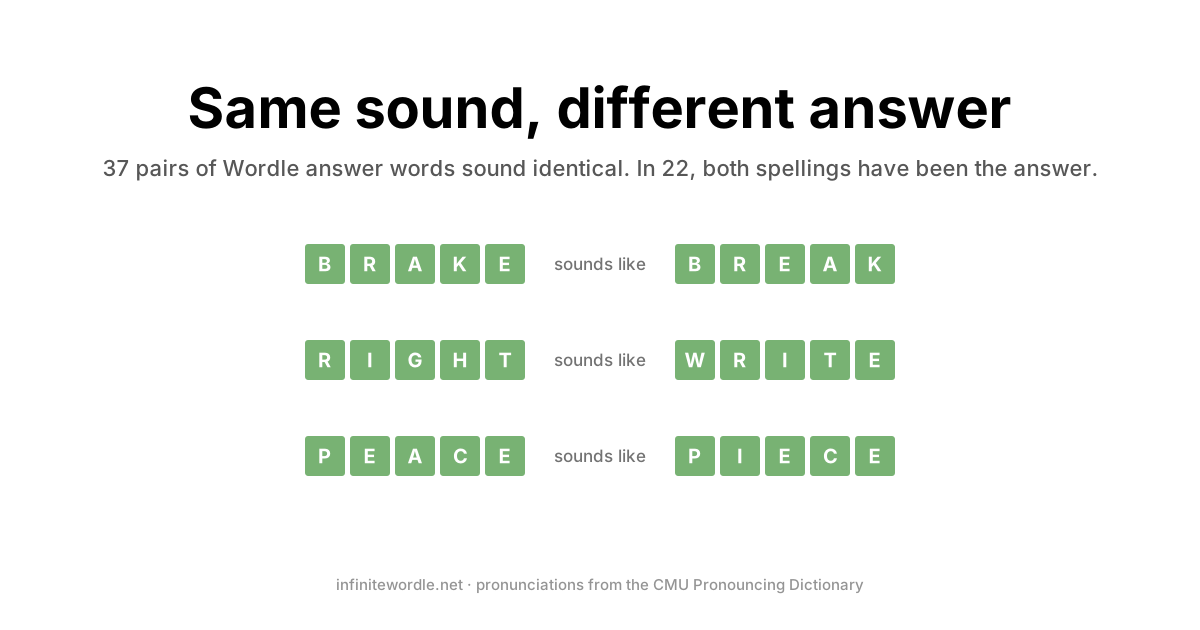
Read a Wordle answer aloud and half the information disappears. BRAKE and BREAK sound the same. So do PLAIN and PLANE, and THEIR and THERE.
To the game, they could not be more different. Wordle scores letters, and a pair that sounds identical can share almost nothing on the board.
We ran every word in Wordle’s answer list through a pronouncing dictionary to find them all. 37 pairs of answer words sound alike, and in 22 of them both spellings have already been the answer.
What you’ll learn:
- Every homophone pair in Wordle’s answer list, and which spellings have been played
- Where on the board the two spellings differ
- The 9 pairs that only sound alike in some accents
- Why homophones are the hard part of playing Wordle by ear
- How to hear the difference for yourself
What Is a Homophone?
A homophone is a word that sounds the same as another but is spelled differently and means something else. BRAKE and BREAK are homophones; so are PEACE and PIECE.
The idea is simple. The details are where it gets interesting, especially when every word has exactly five letters.
Homophones, homographs and homonyms
Three terms get mixed up constantly. A homophone shares a sound, like STEAL and STEEL. A homograph shares a spelling, like the two meanings of WOUND.
A homonym, loosely, is either. This article is only about the first kind: different spellings, same sound.
Why five letters suit them
Most of Wordle’s homophones swap one vowel spelling for another. EA and EE (CREAK, CREEK), AI and A-E (PLAIN, PLANE), EA and IE (PEACE, PIECE).
Five letters is just long enough to fit those vowel teams. It is also short enough that a single swapped pair of letters changes a large share of the word.
Accent decides some of them
Whether two words are homophones depends on who is saying them. MARRY and MERRY are identical for most Americans and clearly different for most British speakers.
We keep those pairs in the list but flag them separately, because they behave differently on the board and in a hint.
A rhyme that starts at the first sound
Every homophone is also a perfect rhyme, taken all the way to the front of the word. All 37 pairs here also sit in the same rhyme set in our analysis of Wordle words that rhyme.
The difference is how much of the word matches. A rhyme matches from the last stressed vowel; a homophone matches from the very first sound.
Every Homophone Pair in Wordle’s Answer List
Here is the full list, with the first date each spelling was a Wordle answer.
| Pair | When each was the answer | Note |
|---|---|---|
| ALTAR / ALTER | ALTAR Nov 3, 2021 · ALTER Jan 20, 2023 | |
| BEACH / BEECH | BEACH Aug 21, 2023 · BEECH never | |
| BERTH / BIRTH | BERTH Jul 10, 2022 · BIRTH Mar 12, 2023 | |
| BRAKE / BREAK | BRAKE Dec 20, 2021 · BREAK Dec 8, 2021 | |
| CHALK / CHOCK | CHALK Aug 1, 2024 · CHOCK Nov 28, 2024 | cot–caught merger |
| CHUTE / SHOOT | CHUTE Sep 17, 2022 · SHOOT never | |
| CREAK / CREEK | CREAK Jun 1, 2022 · CREEK never | |
| CREAM / CREME | CREAM Feb 22, 2025 · CREME never | many say crème as "krem" |
| DRIER / DRYER | DRIER never · DRYER Feb 25, 2025 | |
| FAIRY / FERRY | FAIRY never · FERRY Dec 27, 2021 | Mary–marry–merry merger |
| FIBER / FIBRE | FIBER Oct 19, 2024 · FIBRE never | American vs British spelling |
| FLAIR / FLARE | FLAIR Apr 18, 2022 · FLARE Nov 5, 2023 | |
| FLIER / FLYER | FLIER never · FLYER Jul 18, 2023 | accepted variants of each other |
| GRATE / GREAT | GRATE Sep 24, 2022 · GREAT Nov 2, 2021 | |
| GROAN / GROWN | GROAN Aug 6, 2025 · GROWN May 17, 2025 | |
| HAIRY / HARRY | HAIRY May 3, 2022 · HARRY never | Mary–marry–merry merger |
| HOARD / HORDE | HOARD Mar 7, 2022 · HORDE May 3, 2023 | |
| KNEAD / KNEED | KNEAD Jun 26, 2024 · KNEED never | |
| LEACH / LEECH | LEACH Dec 1, 2025 · LEECH Aug 23, 2024 | |
| MARRY / MERRY | MARRY Jul 16, 2021 · MERRY Oct 2, 2023 | Mary–marry–merry merger |
| MINER / MINOR | MINER Oct 5, 2024 · MINOR never | |
| NAVAL / NAVEL | NAVAL Jun 27, 2021 · NAVEL Mar 8, 2025 | |
| PEACE / PIECE | PEACE Aug 27, 2023 · PIECE Mar 14, 2025 | |
| PLAIN / PLANE | PLAIN Jun 27, 2025 · PLANE Oct 5, 2025 | |
| PLAIT / PLATE | PLAIT Apr 3, 2024 · PLATE Apr 20, 2023 | British PLAIT sounds like "plat" |
| PRIDE / PRIED | PRIDE Jul 19, 2021 · PRIED never | |
| RIGHT / WRITE | RIGHT Sep 24, 2023 · WRITE Aug 28, 2023 | |
| SHEAR / SHEER | SHEAR Apr 3, 2025 · SHEER never | |
| SHONE / SHOWN | SHONE Sep 20, 2026 · SHOWN Apr 27, 2022 | British SHONE rhymes with "gone" |
| STAIR / STARE | STAIR Apr 9, 2022 · STARE Dec 30, 2024 | |
| STAKE / STEAK | STAKE Aug 26, 2024 · STEAK Jul 14, 2026 | |
| STEAL / STEEL | STEAL never · STEEL Apr 13, 2024 | |
| SUITE / SWEET | SUITE May 6, 2025 · SWEET Mar 8, 2022 | |
| THEIR / THERE | THEIR Mar 21, 2022 · THERE Nov 17, 2022 | |
| WAIST / WASTE | WAIST Dec 6, 2025 · WASTE Aug 21, 2022 | |
| WHICH / WITCH | WHICH Feb 6, 2024 · WITCH Nov 26, 2024 | wine–whine merger |
| WHITE / WIGHT | WHITE Dec 20, 2025 · WIGHT never | wine–whine merger |
Both spellings have been the answer
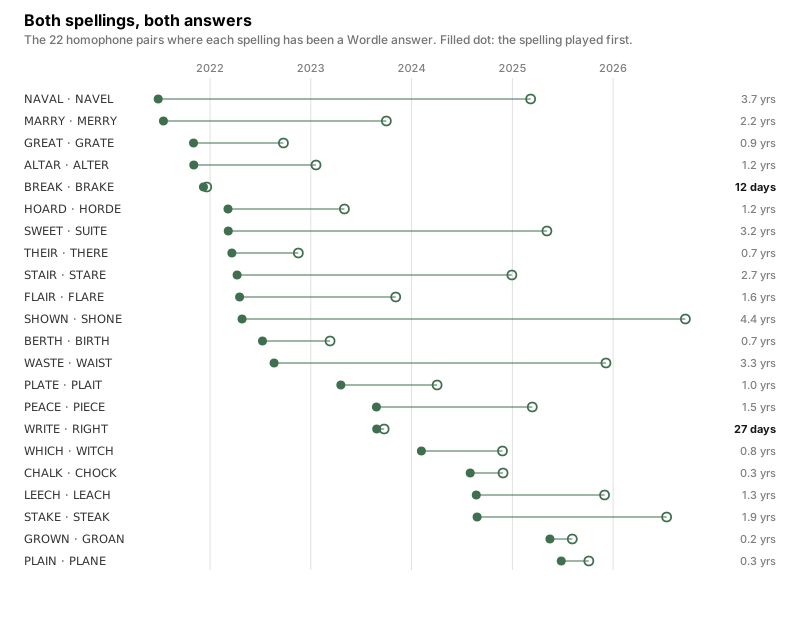
In 22 of the 37 pairs, Wordle has used each spelling at least once. None of the pairs has gone entirely unplayed.
The closest call
The tightest pair is BRAKE and BREAK: 12 days apart. BREAK was puzzle #172 on December 8, 2021, and BRAKE followed as #184 on December 20.
WRITE and RIGHT came close too, 27 days apart in 2023. At the other end, SHONE and SHOWN were separated by 4.4 years.
Wordle has used both spellings of 22 different homophone pairs. The closest were BREAK and BRAKE, just twelve days apart in December 2021.
Twins still waiting
In the other 15 pairs, only one spelling has been the answer. Its twin is still in the pool, unplayed:
| Already an answer | Never been the answer |
|---|---|
| BEACH | BEECH |
| CHUTE | SHOOT |
| CREAK | CREEK |
| CREAM | CREME |
| DRYER | DRIER |
| FERRY | FAIRY |
| FIBER | FIBRE |
| FLYER | FLIER |
| HAIRY | HARRY |
| KNEAD | KNEED |
| MINER | MINOR |
| PRIDE | PRIED |
| SHEAR | SHEER |
| STEEL | STEAL |
| WHITE | WIGHT |
These update with every puzzle. When one of them comes up, it moves into the table above.
Where the Spellings Differ on the Board
A homophone pair is a single sound written two ways. On a Wordle board, what matters is exactly which squares change.
The middle squares carry the difference
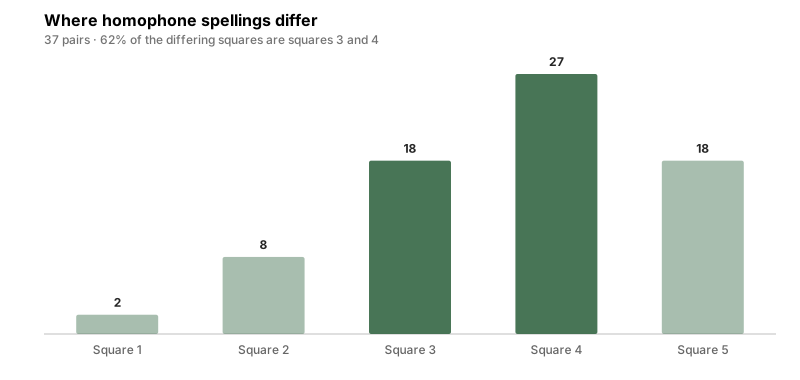
62% of all the squares that differ between two spellings are squares 3 and 4. That is where the vowel teams live: the EA of PEACE against the IE of PIECE.
The first square almost never changes. Only two pairs start with a different letter: RIGHT and WRITE, and CHUTE and SHOOT.
One letter apart, or the same letters reshuffled
15 of the pairs differ in a single square, like ALTAR and ALTER or CREAK and CREEK. A green-heavy board can still leave you with a coin toss.
Another 5 pairs use exactly the same five letters in a different order. BRAKE and BREAK, GRATE and GREAT, STAKE and STEAK are anagrams as well as homophones.
Guess the twin: what the tiles say
Suppose you guess one spelling and the answer is the other. Here is how Wordle would score it.
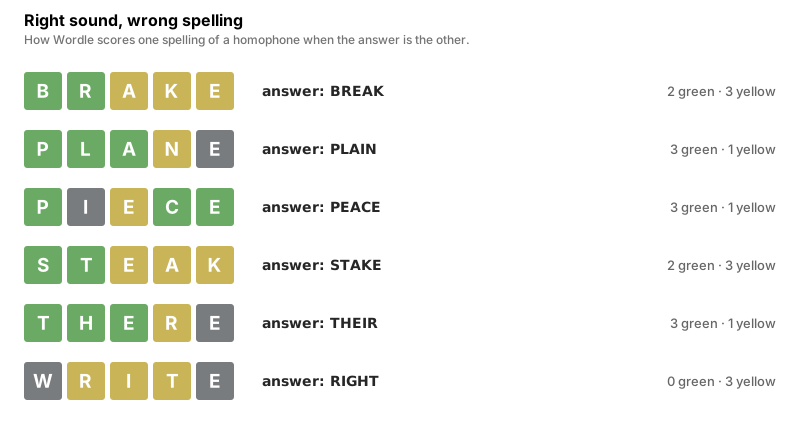
BRAKE against BREAK gives two greens and three yellows: every letter is right, but three are in the wrong place. PLANE against PLAIN gives three greens and a single yellow.
RIGHT and WRITE share nothing
WRITE against RIGHT scores no green tiles at all. The two words share three letters, R, I and T, and every one of them sits in a different square.
That is the extreme case, and a useful one to remember. Sounding right is no evidence that a word is close.
How to break a homophone tie
If your clues fit both spellings, do not name one and hope. Play a word that tests the letters that differ, like the I in PLAIN against the E in PLANE.
The Wordle Solver will show both candidates side by side once your clues narrow things down. Neither spelling is favoured: as the tables above show, the puzzle has happily used both.
Homophones That Depend on Your Accent
9 of the 37 pairs are homophones only in some accents. The pronouncing dictionary we used follows General American speech, where all of them merge.
| Pair | Why it depends on accent |
|---|---|
| CHALK / CHOCK | cot–caught merger |
| CREAM / CREME | many say crème as "krem" |
| FAIRY / FERRY | Mary–marry–merry merger |
| HAIRY / HARRY | Mary–marry–merry merger |
| MARRY / MERRY | Mary–marry–merry merger |
| PLAIT / PLATE | British PLAIT sounds like "plat" |
| SHONE / SHOWN | British SHONE rhymes with "gone" |
| WHICH / WITCH | wine–whine merger |
| WHITE / WIGHT | wine–whine merger |
Mary, marry, merry
MARRY and MERRY, HAIRY and HARRY, FAIRY and FERRY all fall to the same change. Most Americans pronounce the vowels before R identically; many British, Irish and US Northeastern speakers do not.
If you grew up with the distinction, these pairs will not sound like homophones at all.
Which and witch
WHICH and WITCH sound the same for most English speakers today. Some Scottish, Irish and older Southern US speakers still pronounce the WH with a breathy H, which keeps them apart.
WHITE and WIGHT follow the same pattern.
Chalk, chock and the British splits
CHALK and CHOCK merge for speakers with the cot–caught merger, common across the western US and Canada. Elsewhere they stay distinct.
Two more pairs split in British English: British speakers say SHONE to rhyme with “gone” and PLAIT like “plat”. CREAM and CREME only match if you say crème like cream; plenty of speakers on both sides of the Atlantic say “krem”.
Two pairs that are really one word
2 pairs are not homophones in the usual sense. FIBER and FIBRE are the same word in its American and British spelling, and FLIER and FLYER are accepted variants of each other.
We list them because Wordle’s answer pool contains both spellings, which means either could turn up as a puzzle.
Playing Wordle by Ear
For most players, homophones are a curiosity. For players who use a screen reader, they are a practical problem.
How a screen reader presents the board
Blind and low-vision players use screen readers such as VoiceOver, TalkBack, JAWS or NVDA. These turn each tile, letter and result into speech.
When a guess is read as a whole word, the reader pronounces it. That is exactly where homophones cause trouble.
Where homophones get in the way
BRAKE and BREAK read aloud are indistinguishable. So is a friend reading out yesterday’s answer, or a hint given as “it sounds like” a word.
3.0% of Wordle answers so far have had a homophone in the answer list. It is not a daily problem, but it is a recurring one.
”Sounds like” hints
The same trap catches sighted players through hints. A clue that says the answer “sounds like” a word tells you its sound and nothing about its spelling.
For a word with a homophone, that clue fits two answers. Letter-level hints, like the first letter or the vowels, never have that problem, which is why our daily Wordle hints stick to them.
Spell it, don’t say it
Most screen readers can read a word letter by letter on request. For a word with a homophone, that one switch removes the ambiguity entirely.
The same rule works between sighted players. If you are sharing an answer by voice, spell it.
Hear the Difference for Yourself
Reading that MARRY and MERRY split by accent is one thing. Hearing them side by side is more convincing, and quicker.
Why listening helps
Most people cannot hear their own accent’s mergers. If MARRY and MERRY have always sounded the same to you, a written description of the difference does very little.
Hearing two voices say the same pair, one after the other, does far more than any phonetic notation.
A two-voice listening test
Paste the accent pairs from the table above into a text-to-speech tool such as AnySpeech, which offers voices in a range of regional accents. Play each pair in an American voice, then a British one.
In a typical American voice, MARRY and MERRY should come out the same. In a British voice, listen for them to split, along with SHONE and SHOWN, and PLAIT and PLATE.
What to listen for
Start with the vowel right before the R in MARRY and MERRY. Then compare the O in SHONE against SHOWN; in British English it is short, like “gone”.
If a pair still sounds the same in both voices, it is a true homophone for both accents, like most of the 26 universal pairs in the list.
Methodology
Pronunciations. Every word in Wordle’s 2,295-word answer pool was looked up in the CMU Pronouncing Dictionary (Copyright © 1993–2015 Carnegie Mellon University, BSD-style license), which records General American pronunciation.
Pairing. Two words are homophones when their first-listed pronunciations match exactly, stress marks aside. Matching on any listed variant would add one spurious pair, FREED with FRIED, through a single unusual entry.
Classification. The 9 accent-dependent pairs and the 2 spelling variants were classified by hand, from well-documented sound mergers; the dictionary alone cannot make that call.
Coverage. Words the dictionary has no entry for, about one in twenty, cannot be paired and are left out. The real number of homophones in the pool may be slightly higher.
Freshness. The pairs are fixed, because the answer pool is. Which spellings have been played comes from our daily archive of 1,973 puzzles and updates on every site build.