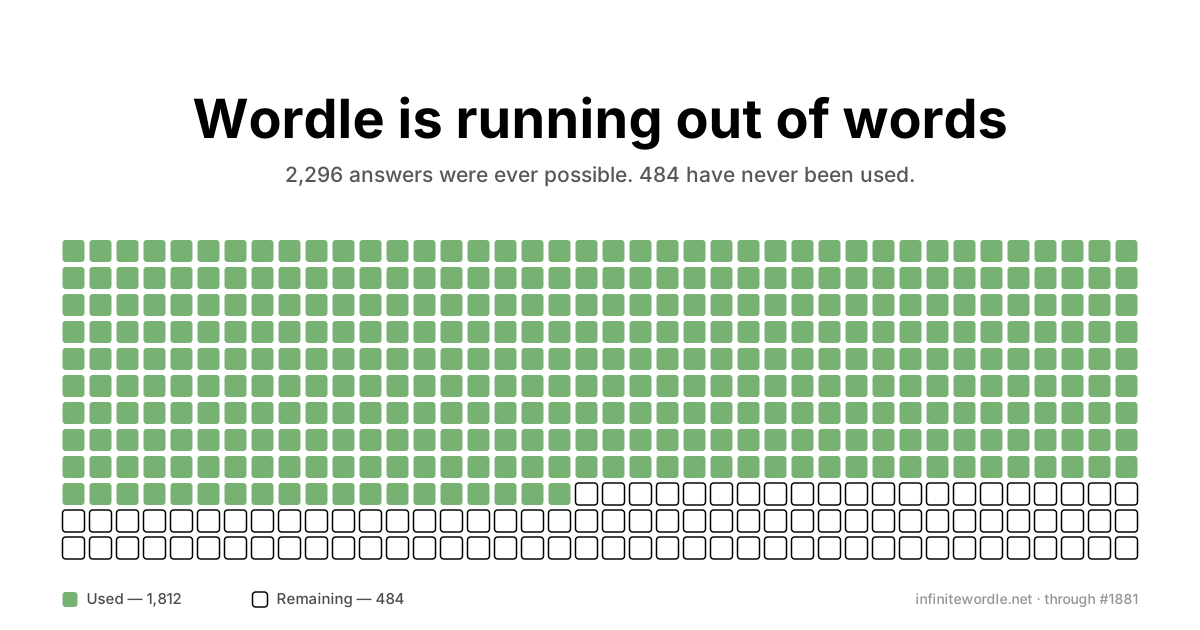
Wordle has a finite supply of answers, and it is closer to the bottom than most players realise. Of the 2,296 words in its curated answer pool, 465 have never been used.
That is about 1.3 years of daily puzzles left in untouched material.
The New York Times appears to have reached the same conclusion, because it has already changed course. After 1,689 consecutive puzzles without ever repeating a word, Wordle started recycling old answers in February 2026.
We keep a daily archive of every puzzle — 1,916 of them, each with its number and date. This is what that archive says about how much game is left.
What you’ll learn:
- Exactly how many answers remain, and which words they are
- The complete record of every repeated answer, with dates and gaps
- Why the first repeat was a deliberate choice, not an accident
- What the change means for how you should guess
- What the Times can do when the pool finally empties
What Is the Wordle Answer Pool?
Wordle runs on two separate word lists, and conflating them is the single most common misunderstanding about the game.
The first is the guess list: roughly 11.4k five-letter words the game will accept when you type them. It includes obscure entries most players would never think of.
The second is the answer pool: 2,296 common words the puzzle can actually choose as a solution. It was curated by hand, and it is far smaller.
Wordle accepts about 11,367 words as guesses but can only ever answer with about 2,296 of them. Roughly four out of every five words you are allowed to type could never be the solution.
Why the pool is so much smaller
The original developer, Josh Wardle, built the answer list by asking his partner which words she recognised. Anything obscure, archaic, or unpleasant was cut.
That is why AGORA and APNEA sit in the pool while equally valid words like ABAKA and KBARS do not. The filter was human judgement, not a dictionary rule.
The result is a list you could read end to end in an afternoon. And a list that finite has an end.
How we know what is in it
The pool is not published by the Times, but it is recoverable: it shipped in the original game’s JavaScript and has been mirrored widely since.
Our archive cross-references that pool against every answer actually used, which is how the remaining count below is derived rather than estimated.
How Much Is Left
As of puzzle #1919 on September 20, 2026, the count stands at:
| Category | Words | Share |
|---|---|---|
| Answer pool, total | 2,296 | 100% |
| Already used | 1,831 | 79.7% |
| Never used | 465 | 20.3% |
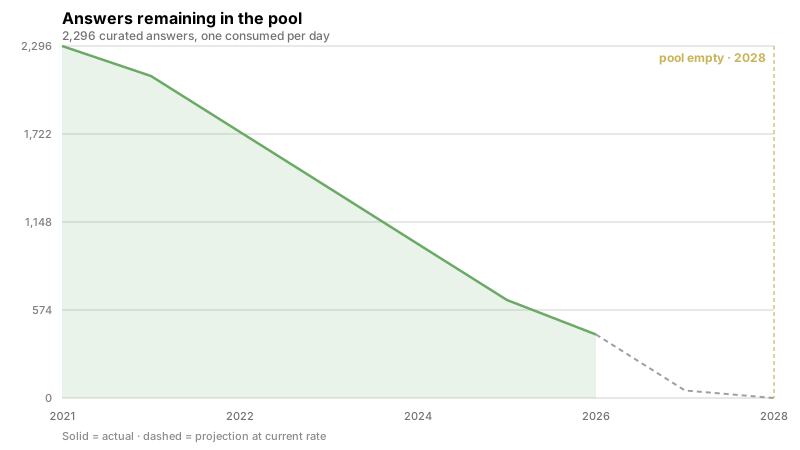
At one puzzle per day, 465 words is roughly 1.3 years — the pool would be spent some time in 2027.
The unused words are not obscure
You might assume what remains is the dregs. It is not.
Here are the first words in the unused list, alphabetically: ABLED, ABODE, ABORT, ABUSE, ADORN, AFIRE, AFOUL, AGORA, AIDER, ALGAE, ALLAY, AMITY, ANIME, ANNUL.
These are ordinary words. ARENA, ABUSE, ALGAE and ARMOR have simply never come up in 1,916 puzzles — which is itself a reminder of how much randomness there is in a five-year sample.
The unused pile skews toward one letter
Grouping the remaining words by first letter shows an uneven distribution:
| First letter | Unused words | Examples |
|---|---|---|
| S | 90 | SADLY, SAFER, SALON |
| C | 37 | CABAL, CABBY, CABIN |
| B | 34 | BAGGY, BASAL, BEECH |
| F | 32 | FAIRY, FATAL, FATTY |
| P | 30 | PADDY, PAGAN, PALER |
| R | 28 | RABBI, RADAR, RADII |
S leads by a wide margin. That is partly because S is the most common opening letter in English five-letter words generally, and partly because the pool simply holds more of them.
The leftovers are harder than what came before
Here is the part that does not show up in a simple countdown: the unused words are not a random sample of the pool. They are systematically different from the ones already spent.
Comparing the 1,831 used words against the 465 unused ones:
| Trait | Already used | Never used |
|---|---|---|
| Repeated letters | 30.8% | 37.8% |
| Ends in E | 20.0% | 12.6% |
| Ends in Y | 13.9% | 22.1% |
| Average vowels | 1.79 | 1.73 |
Every one of those gaps points the same direction. Words with a doubled letter are meaningfully over-represented in what remains, and repeated letters are the single most reliable way to make a Wordle hard.
The unused half of Wordle’s answer pool contains 23% more double-letter words than the half already played. Whatever is left is, on average, harder than what came before.
The E-versus-Y split says the same thing from another angle. An answer ending in E is friendly — it is the most common ending in the pool and the first thing experienced players try. Ending in Y is the awkward case, and those are disproportionately still in the bag.
None of this looks deliberate. It is what happens when a human picks the pleasant, guessable word each morning for four years: the pleasant ones get used up first.
What that means for difficulty
If the Times worked purely through the remaining list, the puzzle would drift harder over the next 1.3 years without anyone deciding to make it harder.
Reusing old answers cuts against that drift, since the reused words come from the friendly end of the distribution. That may be a second reason the policy changed.
Why the real number is fuzzier than it looks
Two caveats keep this from being a countdown clock.
The Times has never confirmed it still uses the original pool unchanged. Editors have added words that were not in Wardle’s list, and removed a few they considered unsuitable.
And as the next section shows, the pool no longer has to be spent at all.
The Times Blinked First: When Repeats Began
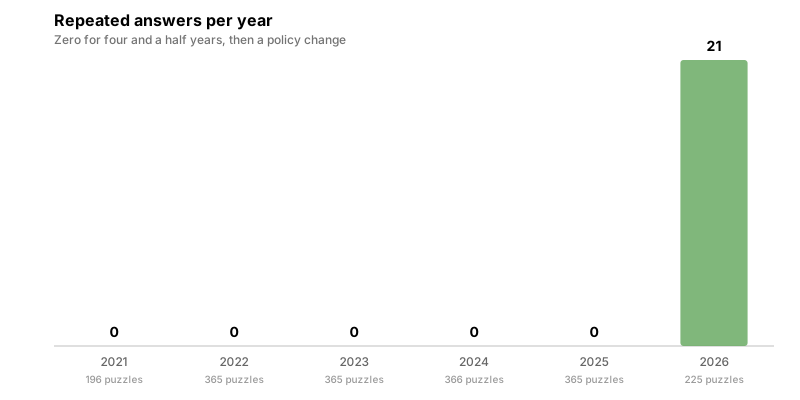
For its first 1,689 puzzles, Wordle never once repeated an answer. Not a single word appeared twice in more than four and a half years.
Then, on February 2, 2026, it did.
Wordle went 1,689 puzzles without a single repeated answer. Since February 2026 there have been 24 — about 9.3% of this year’s puzzles.
The first repeat was not a random pick
The word that broke the streak was CIGAR.
CIGAR was puzzle #0 — the very first Wordle answer, on June 19, 2021. Bringing it back as the first-ever repeat, 1,689 puzzles later, reads as a deliberate editorial gesture rather than an oversight.
Whoever chose it knew what they were doing.
The complete repeat record
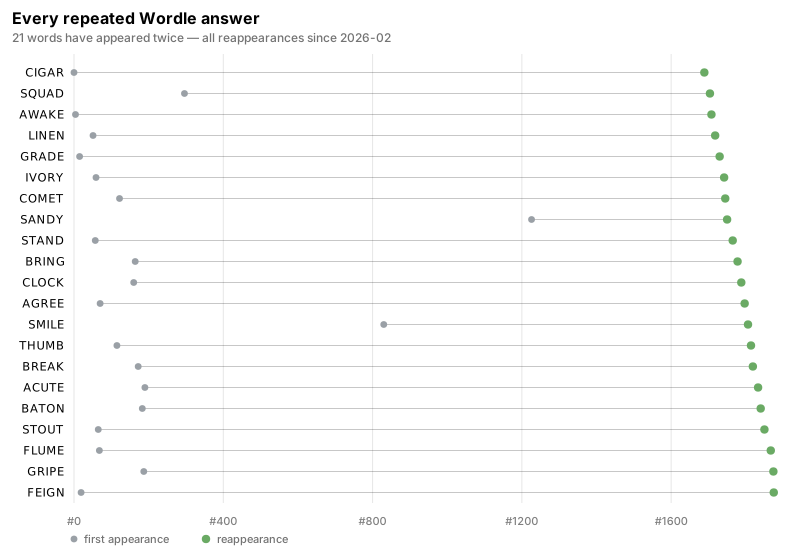
Every repeat to date, oldest reappearance first:
| Word | First appearance | Returned as | Gap |
|---|---|---|---|
| CIGAR | #0 · 2021-06-19 | #1689 · 2026-02-02 | 1,689 puzzles |
| SQUAD | #296 · 2022-04-11 | #1704 · 2026-02-17 | 1,408 puzzles |
| AWAKE | #4 · 2021-06-23 | #1708 · 2026-02-21 | 1,704 puzzles |
| LINEN | #51 · 2021-08-09 | #1718 · 2026-03-03 | 1,667 puzzles |
| GRADE | #15 · 2021-07-04 | #1730 · 2026-03-15 | 1,715 puzzles |
| IVORY | #59 · 2021-08-17 | #1742 · 2026-03-27 | 1,683 puzzles |
| COMET | #122 · 2021-10-19 | #1745 · 2026-03-30 | 1,623 puzzles |
| SANDY | #1226 · 2024-10-27 | #1750 · 2026-04-04 | 524 puzzles |
| STAND | #57 · 2021-08-15 | #1765 · 2026-04-19 | 1,708 puzzles |
| BRING | #164 · 2021-11-30 | #1778 · 2026-05-02 | 1,614 puzzles |
| CLOCK | #160 · 2021-11-26 | #1788 · 2026-05-12 | 1,628 puzzles |
| AGREE | #70 · 2021-08-28 | #1797 · 2026-05-21 | 1,727 puzzles |
| SMILE | #830 · 2023-09-27 | #1806 · 2026-05-30 | 976 puzzles |
| THUMB | #115 · 2021-10-12 | #1814 · 2026-06-07 | 1,699 puzzles |
| BREAK | #172 · 2021-12-08 | #1819 · 2026-06-12 | 1,647 puzzles |
| ACUTE | #190 · 2021-12-26 | #1833 · 2026-06-26 | 1,643 puzzles |
| BATON | #183 · 2021-12-19 | #1840 · 2026-07-03 | 1,657 puzzles |
| STOUT | #65 · 2021-08-23 | #1850 · 2026-07-13 | 1,785 puzzles |
| FLUME | #68 · 2021-08-26 | #1867 · 2026-07-30 | 1,799 puzzles |
| GRIPE | #187 · 2021-12-23 | #1874 · 2026-08-06 | 1,687 puzzles |
| FEIGN | #19 · 2021-07-08 | #1875 · 2026-08-07 | 1,856 puzzles |
| TRACE | #179 · 2021-12-15 | #1889 · 2026-08-21 | 1,710 puzzles |
| CLICK | #134 · 2021-10-31 | #1893 · 2026-08-25 | 1,759 puzzles |
| FOCUS | #267 · 2022-03-13 | #1912 · 2026-09-13 | 1,645 puzzles |
They are reaching back to the beginning
The pattern in that table is not subtle. 20 of the 24 reused words originally ran during Wordle’s first calendar year.
The average gap is 1,606 puzzles. The longest is 1,856; the shortest is 524.
That choice makes sense. A word last seen in 2021 is invisible to most of the current audience, since Wordle’s player base turned over substantially after the Times acquired it.
The gap is the safety margin
Reusing a word from 524 puzzles ago is riskier than one from 1,800 puzzles ago — a dedicated player might genuinely remember it.
The concentration at the long end of the range suggests the editors are picking gaps deliberately rather than sampling at random.
Why now
The Times has not announced a policy change, so the reason has to be inferred. Two explanations fit the timing.
The obvious one is arithmetic. Repeats began when the unused pool was already down to a few hundred words — exactly when a curator would start thinking about supply.
The subtler one is quality. Expanding the pool means admitting words the original curation rejected as too obscure. Reusing a well-liked old answer keeps the difficulty consistent in a way that promoting KBARS never could.
What This Changes About How You Guess
For four years, one deduction was airtight: if a word had already been an answer, it could not be today’s answer. That is no longer true.
”Already used” is now evidence, not proof
At roughly 9.3% of this year’s puzzles, repeats are uncommon but no longer negligible.
Practically: when two candidates fit all your clues and one has been an answer before, prefer the unused one — but do not eliminate the other outright.
That is a meaningful downgrade from the old rule, and it costs games for players still applying the old logic.
Old answers are back in play
If you have been discarding candidates because you remember them from 2021, stop. Those are precisely the words the Times is drawing from.
The 24 reused words so far skew heavily toward that era, and there is no sign the pattern is stopping.
Where the archive actually helps
Checking the full answer archive is most useful in one specific spot: you are down to two or three candidates, and the clues cannot separate them.
Then the question “has this been used, and how recently?” becomes a genuine tiebreaker. A word used 300 puzzles ago is a far worse bet than one never used at all.
For the mechanical work of narrowing candidates in the first place, the Wordle Solver does it faster than memory.
What Happens When the Pool Empties
Assume the unused list runs to zero. The Times has three options, and the data suggests it has already picked one.
Option 1: Expand the pool
There are about 9,071 accepted guess words outside the answer pool. Promoting even a fraction would add years.
The cost is difficulty. Those words were excluded for being obscure, and players notice immediately when a puzzle answer is a word they have never met.
Option 2: Full rotation
Simply cycle the whole pool from the beginning. This is the cleanest solution and the most predictable — which is also its problem, since a predictable list is a solvable list.
Option 3: Selective reuse
Keep the pool as the backbone and reintroduce old answers at a low rate, choosing long gaps.
This is what is happening now. The 24 repeats to date are all long-gap reintroductions, averaging 1,606 puzzles apart.
The likely end state
Blending options 1 and 3 keeps the puzzle running indefinitely without a visible difficulty cliff. Nothing in the current data contradicts that.
The practical answer to “will Wordle run out of words” is therefore no — but the version you play in 2028 will draw from a different distribution than the one you played in 2022.
Methodology
Every number here comes from our own archive rather than a third-party list.
Source. Daily answers are fetched from the New York Times’ public dated endpoint and committed automatically each morning. The archive currently holds 1,916 puzzles, from June 19, 2021 through September 20, 2026.
Answer pool. The 2,296-word curated pool, as it shipped in the original game and is mirrored in our game engine. “Unused” means present in that pool with no matching entry in the archive.
Repeats. A repeat is any word appearing as the answer on two distinct puzzle numbers. Gaps are measured in puzzle numbers, not days, so they are unaffected by the numbering offsets that appeared early in the game’s history.
Freshness. These figures recompute on every site build. The bots commit a new answer daily, so the counts above track the live puzzle rather than the publication date of this article.
Limits worth stating. We cannot see the Times’ internal word list, so “unused” means unused from the original pool. If editors have added words we do not know about, the true remaining count is higher than 465.